What Was the Name Given to Those Who Opposed the New Constitution?
| Anti-Federalists | |
|---|---|
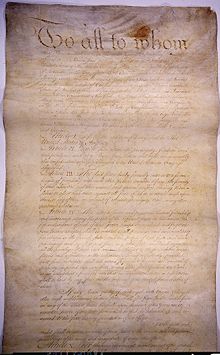 The Articles of Confederation, predecessor to the U.S. Constitution and drafted from Anti-Federalist principles | |
| Leader | Patrick Henry |
| Founded | 1787 (1787) |
| Dissolved | 1789 (1789) |
| Split from | Patriots |
| Succeeded by | Anti-Administration party |
| Ideology | Confederalism Decentralization Liberalism Republicanism |
| |
Anti-Federalism was a late-18th century political movement that opposed the creation of a stronger U.S. federal government and which later opposed the ratification of the 1787 Constitution. The previous constitution, chosen the Manufactures of Confederation and Perpetual Spousal relationship, gave state governments more authority. Led by Patrick Henry of Virginia, Anti-Federalists worried, among other things, that the position of president, then a novelty, might evolve into a monarchy. Though the Constitution was ratified and supplanted the Articles of Confederation, Anti-Federalist influence helped atomic number 82 to the passage of the Neb of Rights.
Main behavior [edit]
- They believed the Constitution needed a Bill of Rights.
- They believed the Constitution created a presidency so powerful that it would become a monarchy.
- They believed the Constitution provided insufficient rights in the courts (due east.g., no guarantee of juries in ceremonious cases, nor that criminal example juries exist local) and would create an out-of-control judiciary.
- They believed that the national government would be too far away from the people and thus unresponsive to the needs of localities.
- They believed the Constitution would abrogate, at least in part, the power of the states.[ane] [ better source needed ]
History [edit]
During the American Revolution and its immediate aftermath, the term federal was practical to any person who supported the colonial marriage and the government formed nether the Articles of Confederation. After the war, the group that felt the national government under the Articles was too weak appropriated the name Federalist for themselves. Historian Jackson Turner Main wrote, "to them, the homo of 'federal principles' approved of 'federal measures,' which meant those that increased the weight and authority or extended the influence of the Confederation Congress."[2]
As the Federalists moved to ameliorate the Articles, somewhen leading to the Constitutional Convention, they applied the term anti-federalist to their opposition. The term implied, correctly or non, both opposition to Congress and unpatriotic motives. The Anti-Federalists rejected the term, arguing that they were the true Federalists. In both their correspondence and their local groups, they tried to capture the term. For example, an unknown anti-federalist signed his public correspondence as "A Federal Farmer" and the New York commission opposing the Constitution was called the "Federal Republican Commission." However the Federalists carried the day and the name Anti-Federalist forever stuck.[2]
The Anti-Federalists were composed of diverse elements, including those opposed to the Constitution because they thought that a stronger regime threatened the sovereignty and prestige of the states, localities, or individuals; those that saw in the proposed government a new centralized, disguised "monarchic" power that would only replace the cast-off despotism of Great Britain;[three] and those who simply feared that the new authorities threatened their personal liberties. Some of the opposition believed that the fundamental authorities nether the Articles of Confederation was sufficient. Still others believed that while the national government under the Manufactures was besides weak, the national government under the Constitution would be also strong. Some other complaint of the Anti-Federalists was that the Constitution provided for a centralized rather than federal regime (and in The Federalist Papers, James Madison admits that the new Constitution has the characteristics of both a centralized and federal form of the government) and that a truly federal form of government was a leaguing of states as nether the Manufactures of Confederation.
During the period of argue over the ratification of the Constitution, numerous independent local speeches and articles were published all across the land. Initially, many of the articles in opposition were written under pseudonyms, such every bit "Brutus" (likely Melancton Smith),[iv] "Centinel" (probable Samuel Bryan), and "Federal Farmer." Eventually, famous revolutionary figures such every bit Patrick Henry came out publicly against the Constitution. They argued that the strong national authorities proposed past the Federalists was a threat to the rights of individuals and that the president would become a king. They objected to the federal court system created by the proposed constitution. Minority groups besides contributed, such equally Mercy Otis Warren who disguise herself every bit "A Colombian Patriot" , who was idea to be Elbridge Gerry.[v] Warrens nigh notable pamphlet discusses the treatment of minorities and American natural rights, this pamphlet was titled "History of the Rise, Progress, and Termination of the American Revolution".[six] This produced a phenomenal trunk of political writing; the all-time and nigh influential of these articles and speeches were gathered by historians into a collection known every bit the Anti-Federalist Papers in innuendo to the Federalist Papers.
In many states the opposition to the Constitution was strong (although Delaware, Georgia, and New Bailiwick of jersey ratified quickly with little controversy), and in 2 states—Due north Carolina and Rhode Isle—it prevented ratification until the definite establishment of the new government practically forced their adherence. Individualism was the strongest element of opposition; the necessity, or at least the desirability, of a beak of rights was almost universally felt.[3] In Rhode Isle, resistance against the Constitution was then strong that civil war most bankrupt out on July 4, 1788, when anti-federalist members of the Country Party led past Approximate William West marched into Providence with over 1,000 armed protesters.[7]
The Anti-Federalists played upon these feelings in the ratification convention in Massachusetts. Past this point, five of the states had ratified the Constitution with relative ease, but the Massachusetts convention was far more disputed and contentious. After a long fence, a compromise (known as the "Massachusetts compromise") was reached. Massachusetts would ratify the Constitution with recommended provisions in the ratifying instrument that the Constitution be amended with a nib of rights. (The Federalists contended that a conditional ratification would be void, so the recommendation was the strongest support that the ratifying convention could requite to a bill of rights short of rejecting the Constitution.)
Four of the adjacent five states to ratify, including New Hampshire, Virginia, and New York, included similar language in their ratification instruments. As a issue, one time the Constitution became operative in 1789, Congress sent a ready of twelve amendments to the states. X of these amendments were immediately ratified and became known as the Nib of Rights, with one of the other two becoming the 27th Amendment—nearly 200 years after. Thus, while the Anti-Federalists were unsuccessful in their quest to forbid the adoption of the Constitution, their efforts were non totally in vain. The Anti-Federalists thus became recognized as an influential group among the Founding Fathers of the U.s.a..
With the passage of the Constitution and the Bill of Rights, the Anti-Federalist movement was wearied. Some activists joined the Anti-Administration Political party that James Madison and Thomas Jefferson were forming about 1790–91 to oppose the policies of Treasury Secretary Alexander Hamilton; this group soon became the Democratic-Republican Party.[8] When Jefferson took office equally the third president in 1801, he replaced Federalist appointees with Democratic-Republicans and sought to focus on bug that allowed united states to make more of their own decisions in matters. He also repealed the whiskey excise and other federal taxes, shut down some federal offices and broadly sought to change the financial organisation that Hamilton had created.[9]
Notable Anti-Federalists [edit]
|
|
See also [edit]
- Albany Antifederal Committee
- Anti-Federalist Papers
- The Complete Anti-Federalist
- Country Party (Rhode Island)
- New Federalism
- Subsidiarity
References [edit]
- ^ "Thomas Jefferson and the Anti-Federalists". HIS2011- Federalists verse Anit- Federalists. Suffern High Schoolhouse.
- ^ a b Main, Jackson Turner (1961). The Antifederalists: Critics of the Constitution, 1781-1788. The Academy of North Carolina Press. ISBN0-8078-5544-viii.
- ^ a b One or more of the preceding sentences incorporates text from a publication at present in the public domain:Chisholm, Hugh, ed. (1911). "Anti-Federalists". Encyclopædia Britannica. Vol. ii (11th ed.). Cambridge University Press. p. 124.
- ^ Zuckert and Webb. The Anti-Federalist Writings of the Melancton Smith Circumvolve pp. 418–419
- ^ Amar, Akhil (1995-01-01). "Women and the Constitution". Faculty Scholarship Series.
- ^ "Mercy Otis Warren (1728-1814)". George Washington'southward Mount Vernon . Retrieved 2022-03-08 .
- ^ Columbian Centinel, July five, 12, 16, 23, 1788; Pennsylvania Packet, July 30, 1788. (reference to West's anti-Constitution quaternary of July rally)
- ^ Kenneth F.Warren (2008). Encyclopedia of U.S. Campaigns, Elections, and Electoral Behavior. SAGE Publications. p. 176. ISBN9781412954891.
- ^ "What Were Some Examples of Thomas Jefferson's Anti-Federalist Views?". Reference. Archived from the original on 2019-04-21.
- ^ a b c d "16b. Antifederalists". ushistory.org. Archived from the original on eight October 2016. Retrieved 10 July 2013.
- ^ LeRoy, Marcel (5 July 2002). "Sam Adams – Father of the American Revolution". The Voice news. Archived from the original on 27 Apr 2014. Retrieved 10 July 2013.
- ^ Wakelyn, Jon 50. (2004). Birth of the Bill of Rights: Biographies. Greenwood Publishing Grouping. p. 7. ISBN978-0-313-33194-7.
- ^ "Letter of the alphabet to John Lamb from Joshua Atherton. Role of the John Lamb papers" (PDF).
- ^ "Lesson 1: Anti-federalist Arguments Confronting "A Consummate Consolidation"". The National Endowment for the Humanities. Retrieved 10 July 2013.
- ^ a b c Willick, Jason (July 3, 2019). "The Founders Who Opposed the Constitution: The Anti-Federalists gave united states of america the Pecker of Rights. Gauge Andrew Oldham says they can also requite the states insight on the modern authoritative state". Wall Street Periodical.
In 1789, when Rep. Madison introduced the outset x amendments in the Showtime Congress, he was making a concession to the Anti-Federalists. Those writers and politicians—including Robert Yates, Mercy Otis Warren and Richard Henry Lee—opposed the original Constitution.
- ^ Ketcham, Ralph (1971). "James Madison: A Biography". American Political Biography Printing. p. 259.
- ^ O'Connor, Thomas H.; Rogers, Alan (1987). This Momentous Affair: Massachusetts and the Ratification of the Constitution of the United States. Trustees of the Public Library of the City of Boston. p. 19 – via Net Annal.
- ^ Ketcham, Ralph (1971). "James Madison: A Biography". American Political Biography Press. p. 234.
- ^ Amar, Akhil Reed (1995). "Women and the Constitution". Yale Constabulary Schoolhouse. Retrieved 10 July 2013.
- ^ "The Anti-Federalist Papers". The Federalist Papers . Retrieved 22 Feb 2021.
- ^ Levine, David. "All-time Clinton Ever? Why New York'south Beginning Governor, George Clinton, Totally Rocks". Hudson Valley. Retrieved 8 May 2016.
- ^ Kauffman, Neb (2008). "Forgotten Founder, Drunken Prophet: The Life of Luther Martin". ISI Books. p. 225. ISBN9781933859736.
- ^ Siemers, David J. (Oct 1, 1998). ""It is Natural to Care for the Crazy Machine": The Antifederalists' Post-Ratification Amenability"". Studies in American Political Evolution. 12 (2): 383–410. doi:10.1017/S0898588X98001576. Retrieved 22 February 2021.

Farther reading [edit]
- Lim, Elvin (2014). The Lovers' Quarrel: The Two Foundings & American Political Evolution. Oxford Academy Press. ISBN978-0-1998-1218-nine.
- Amar, Akhil Reed (2005). "In the Start". America's Constitution: A Biography. New York: Random Firm. ISBN1-4000-6262-4.
- Cornell, Saul (1999). The Other Founders: Anti-Federalism and the Dissenting Tradition in America, 1788–1828. The Academy of North Carolina Press. ISBN0-8078-4786-0.
- Harding, S. B. (1896). Contest over the Ratification of the Federal Constitution in … Massachusetts. Harvard University Studies.
- Libby, O.1000. (1894). Geographical Distribution of the Vote … on the Federal Constitution, 1787–1788. University of Wisconsin.
- Rutland, Robert Allen (1966). The Ordeal of the Constitution: The Antifederalists and the Ratification Struggle of 1787-1788 . Norman: University of Oklahoma Press.
- Storing, Herbert J. (1981). What the Anti-Federalists Were For: The Political Thought of the Opponents of the Constitution. University of Chicago Press. ISBN0-226-77574-7.
External links [edit]
- "Founders' Constitution". Academy of Chicago. 1987.
- A New Nation Votes: American Election Returns, 1787–1825
prichardflaid2002.blogspot.com
Source: https://en.wikipedia.org/wiki/Anti-Federalism
0 Response to "What Was the Name Given to Those Who Opposed the New Constitution?"
Post a Comment